
Overview
LangFlow is a powerful tool for building AI chatbots using a drag-and-drop interface. This integration allows you to connect your LangFlow chatbots to Pactory and monetize them.Prerequisites
- A LangFlow agent deployed and running
- Your LangFlow API endpoint URL
- Your LangFlow API key
Integration Steps
1
LangFlow Agent Setup
- Basic Setup
- Advanced Setup
For a basic setup, you need to create a custom LangFlow component for the highlighted input block on the screenshot, and paste in the following code.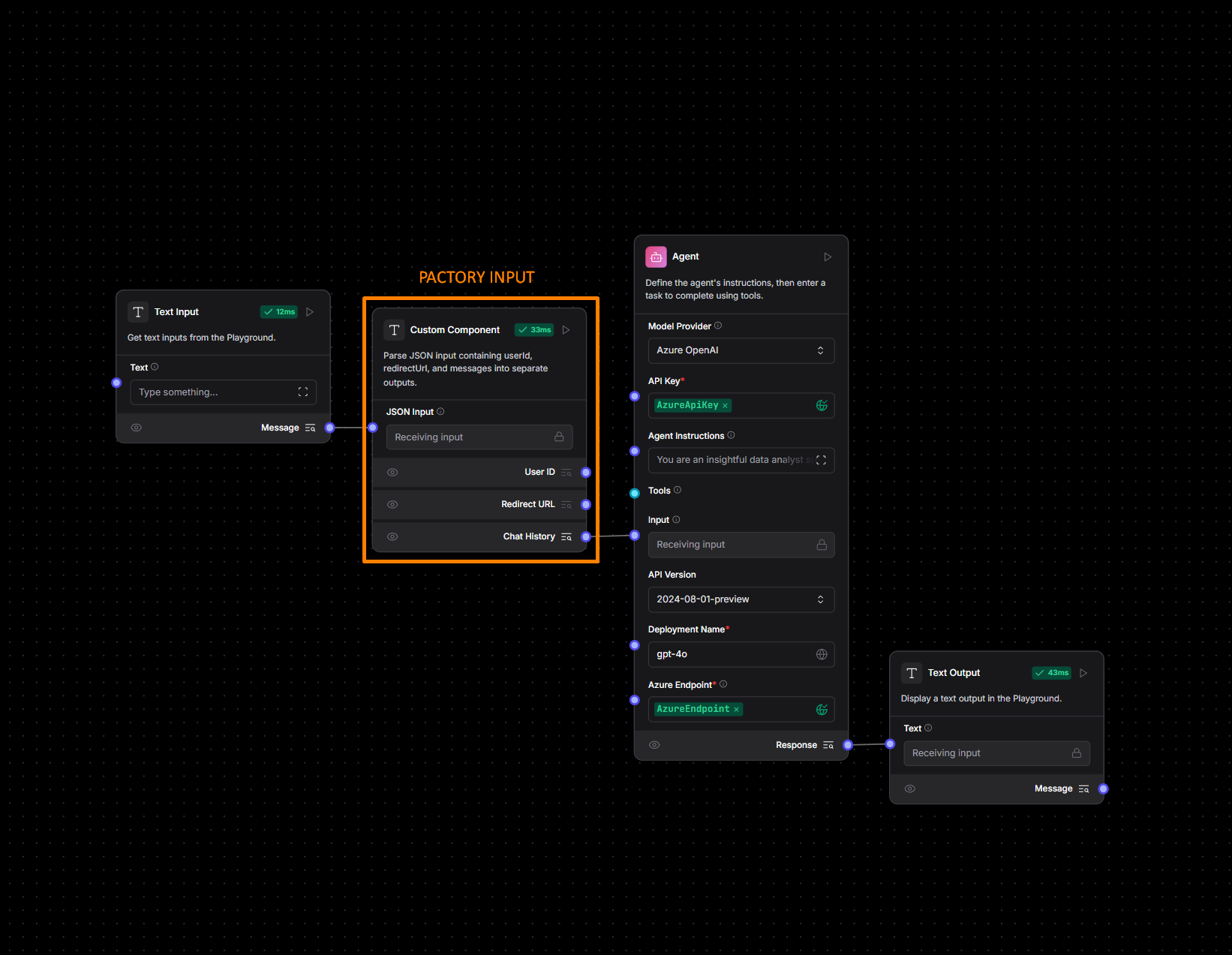
Code Block
Code Block
import json
from langflow.base.io.text import TextComponent
from langflow.io import MultilineInput, Output
from langflow.schema.message import Message
from langflow.utils.constants import MESSAGE_SENDER_AI, MESSAGE_SENDER_USER
from langflow.field_typing import BaseChatMessageHistory
from langchain.memory import ChatMessageHistory


class ParseInputComponent(TextComponent):
    display_name = "Parse Input"
    description = "Parse JSON input containing userId, redirectUrl, messages, and uploads into separate outputs."
    icon = "type"
    name = "ParseInput"

    inputs = [
        MultilineInput(
            name="input_value",
            display_name="JSON Input",
            info="JSON containing userId, redirectUrl, messages array, and uploads array.",
        ),
    ]

    outputs = [
        Output(display_name="User ID", name="user_id", method="get_user_id"),
        Output(display_name="Redirect URL", name="redirect_url", method="get_redirect_url"),
        Output(display_name="Chat History", name="chat_history", method="get_chat_history"),
        Output(display_name="Uploads", name="uploads", method="get_uploads"),
    ]

    def parse_json(self):
        try:
            if not hasattr(self, '_parsed_data'):
                self._parsed_data = json.loads(self.input_value)
            return self._parsed_data
        except json.JSONDecodeError:
            self.status = "Invalid JSON input"
            return {"userId": "default", "redirectUrl": "", "messages": [], "uploads": []}

    def get_user_id(self) -> Message:
        data = self.parse_json()
        user_id = data.get("userId", "default")
        return Message(text=user_id)

    def get_redirect_url(self) -> Message:
        data = self.parse_json()
        redirect_url = data.get("redirectUrl", "")
        return Message(text=redirect_url)

    def get_chat_history(self) -> Message:
        data = self.parse_json()
        formatted_messages = []

        for msg in data.get("messages", []):
            text = msg.get("text", "")
            sender = msg.get("sender", "HUMAN")

            if sender.upper() in ["AI", MESSAGE_SENDER_AI]:
                formatted_messages.append(f"AI: {text}")
            else:
                formatted_messages.append(f"User: {text}")

        chat_history = "\n".join(formatted_messages)
        return Message(text=chat_history)

    def get_uploads(self) -> Message:
        data = self.parse_json()
        uploads = data.get("uploads", [])
        return Message(text=json.dumps(uploads))
For advanced setup, that allows for transfering of authentication links from Composio to user, you need to create a custom component for each of the highlighted input blocks on the screenshot, and paste in the following code.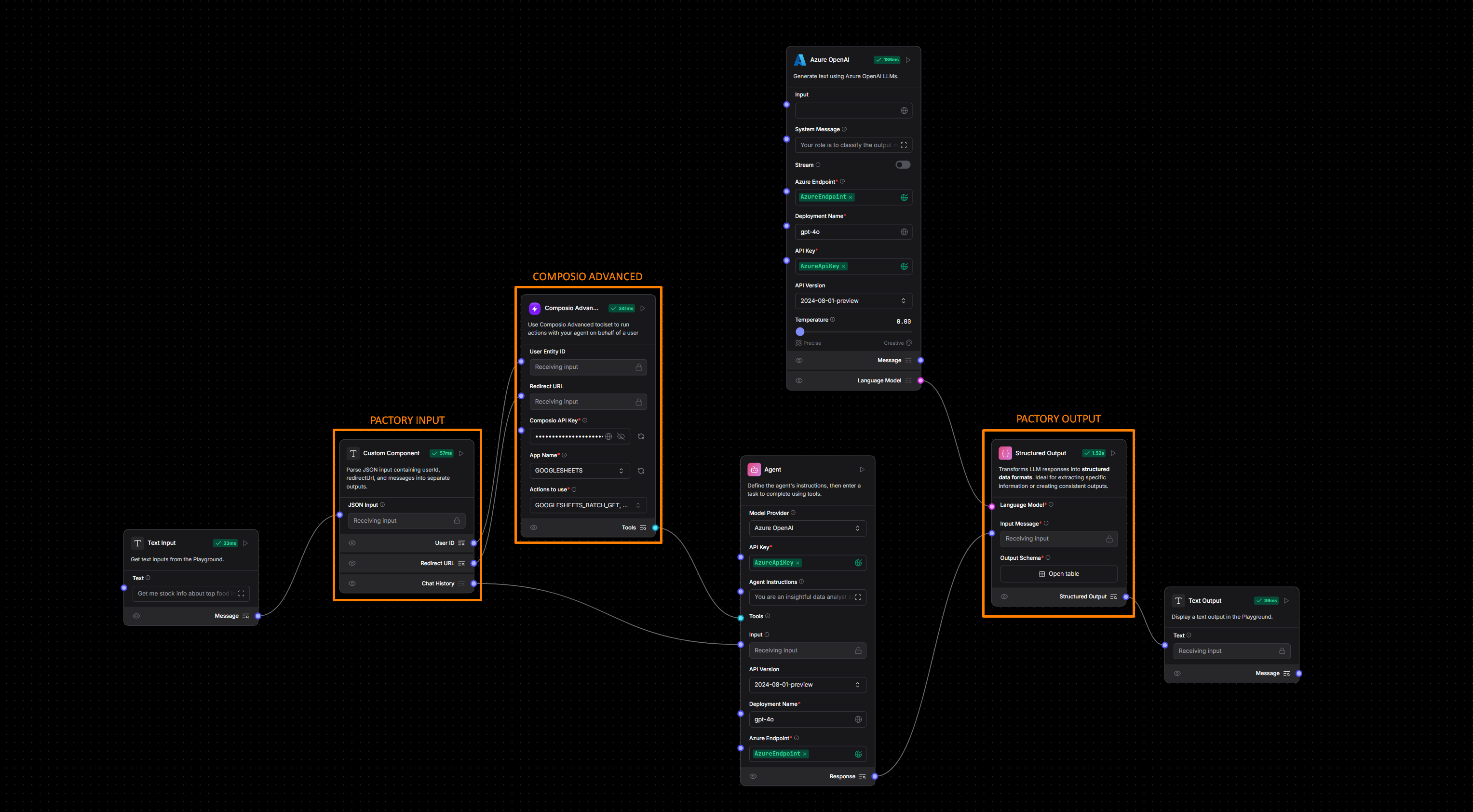
Code Blocks
Code Blocks
      import json
      from langflow.base.io.text import TextComponent
      from langflow.io import MultilineInput, Output
      from langflow.schema.message import Message
      from langflow.utils.constants import MESSAGE_SENDER_AI, MESSAGE_SENDER_USER
      from langflow.field_typing import BaseChatMessageHistory
      from langchain.memory import ChatMessageHistory


      class ParseInputComponent(TextComponent):
          display_name = "Parse Input"
          description = "Parse JSON input containing userId, redirectUrl, messages, and uploads into separate outputs."
          icon = "type"
          name = "ParseInput"

          inputs = [
              MultilineInput(
                  name="input_value",
                  display_name="JSON Input",
                  info="JSON containing userId, redirectUrl, messages array, and uploads array.",
              ),
          ]

          outputs = [
              Output(display_name="User ID", name="user_id", method="get_user_id"),
              Output(display_name="Redirect URL", name="redirect_url", method="get_redirect_url"),
              Output(display_name="Chat History", name="chat_history", method="get_chat_history"),
              Output(display_name="Uploads", name="uploads", method="get_uploads"),
          ]

          def parse_json(self):
              try:
                  if not hasattr(self, '_parsed_data'):
                      self._parsed_data = json.loads(self.input_value)
                  return self._parsed_data
              except json.JSONDecodeError:
                  self.status = "Invalid JSON input"
                  return {"userId": "default", "redirectUrl": "", "messages": [], "uploads": []}

          def get_user_id(self) -> Message:
              data = self.parse_json()
              user_id = data.get("userId", "default")
              return Message(text=user_id)

          def get_redirect_url(self) -> Message:
              data = self.parse_json()
              redirect_url = data.get("redirectUrl", "")
              return Message(text=redirect_url)

          def get_chat_history(self) -> Message:
              data = self.parse_json()
              formatted_messages = []

              for msg in data.get("messages", []):
                  text = msg.get("text", "")
                  sender = msg.get("sender", "HUMAN")

                  if sender.upper() in ["AI", MESSAGE_SENDER_AI]:
                      formatted_messages.append(f"AI: {text}")
                  else:
                      formatted_messages.append(f"User: {text}")

              chat_history = "\n".join(formatted_messages)
              return Message(text=chat_history)

          def get_uploads(self) -> Message:
              data = self.parse_json()
              uploads = data.get("uploads", [])
              return Message(text=json.dumps(uploads))
from typing import TYPE_CHECKING, cast

from pydantic import BaseModel, Field, create_model

from langflow.base.models.chat_result import get_chat_result
from langflow.custom import Component
from langflow.helpers.base_model import build_model_from_schema
from langflow.io import BoolInput, HandleInput, MessageTextInput, Output, StrInput, TableInput
from langflow.schema.data import Data
from langflow.schema.message import Message

if TYPE_CHECKING:
    from langflow.field_typing.constants import LanguageModel


class StructuredOutputComponent(Component):
    display_name = "Structured Output"
    description = (
        "Transforms LLM responses into **structured data formats**. Ideal for extracting specific information "
        "or creating consistent outputs."
    )
    name = "StructuredOutput"
    icon = "braces"

    inputs = [
        HandleInput(
            name="llm",
            display_name="Language Model",
            info="The language model to use to generate the structured output.",
            input_types=["LanguageModel"],
            required=True,
        ),
        MessageTextInput(
            name="input_value",
            display_name="Input Message",
            info="The input message to the language model.",
            tool_mode=True,
            required=True,
        ),
        StrInput(
            name="schema_name",
            display_name="Schema Name",
            info="Provide a name for the output data schema.",
            advanced=True,
        ),
        TableInput(
            name="output_schema",
            display_name="Output Schema",
            info="Define the structure and data types for the model's output.",
            required=True,
            table_schema=[
                {
                    "name": "name",
                    "display_name": "Name",
                    "type": "str",
                    "description": "Specify the name of the output field.",
                    "default": "field",
                },
                {
                    "name": "description",
                    "display_name": "Description",
                    "type": "str",
                    "description": "Describe the purpose of the output field.",
                    "default": "description of field",
                },
                {
                    "name": "type",
                    "display_name": "Type",
                    "type": "str",
                    "description": (
                        "Indicate the data type of the output field (e.g., str, int, float, bool, list, dict)."
                    ),
                    "default": "text",
                },
                {
                    "name": "multiple",
                    "display_name": "Multiple",
                    "type": "boolean",
                    "description": "Set to True if this output field should be a list of the specified type.",
                    "default": "False",
                },
            ],
            value=[{"name": "field", "description": "description of field", "type": "text", "multiple": "False"}],
        ),
        BoolInput(
            name="multiple",
            advanced=True,
            display_name="Generate Multiple",
            info="Set to True if the model should generate a list of outputs instead of a single output.",
        ),
    ]

    outputs = [
        Output(name="structured_output", display_name="Structured Output", method="build_structured_output"),
    ]

    def build_structured_output(self) -> Message:
        schema_name = self.schema_name or "OutputModel"

        if not hasattr(self.llm, "with_structured_output"):
            msg = "Language model does not support structured output."
            raise TypeError(msg)
        if not self.output_schema:
            msg = "Output schema cannot be empty"
            raise ValueError(msg)

        # Create a new schema that includes the original value and the structured fields
        output_model_ = build_model_from_schema(self.output_schema)
        combined_fields = {
            "value": (str, Field(description="Original input message")),
            **{field["name"]: (str if field["type"] == "text" else eval(field["type"]), Field(description=field["description"]))
               for field in self.output_schema}
        }

        if self.multiple:
            output_model = create_model(
                schema_name,
                objects=(list[create_model(schema_name + "Item", **combined_fields)],
                        Field(description=f"A list of {schema_name}."))
            )
        else:
            output_model = create_model(schema_name, **combined_fields)

        try:
            llm_with_structured_output = cast("LanguageModel", self.llm).with_structured_output(schema=output_model)  # type: ignore[valid-type, attr-defined]
        except NotImplementedError as exc:
            msg = f"{self.llm.__class__.__name__} does not support structured output."
            raise TypeError(msg) from exc

        config_dict = {
            "run_name": self.display_name,
            "project_name": self.get_project_name(),
            "callbacks": self.get_langchain_callbacks(),
        }

        # Include the original input value in the context
        context = {"value": self.input_value}
        output = get_chat_result(runnable=llm_with_structured_output, input_value=self.input_value, config=config_dict)

        if isinstance(output, BaseModel):
            output_dict = output.model_dump()
            if not self.multiple:
                output_dict["value"] = self.input_value
            else:
                for item in output_dict["objects"]:
                    item["value"] = self.input_value
        else:
            msg = f"Output should be a Pydantic BaseModel, got {type(output)} ({output})"
            raise TypeError(msg)

        import json
        return Message(text=json.dumps(output_dict))
from collections.abc import Sequence
from typing import Any

from composio.client.collections import AppAuthScheme
from composio.client.exceptions import NoItemsFound
from composio_langchain import Action, App, ComposioToolSet
from langchain_core.tools import Tool
from loguru import logger
from typing_extensions import override

from langflow.base.langchain_utilities.model import LCToolComponent
from langflow.inputs import DropdownInput, MessageTextInput, SecretStrInput, StrInput, MultiselectInput
from langflow.io import Output


class ComposioAdvancedComponent(LCToolComponent):
display_name: str = "Composio Advanced Tools"
description: str = "Use Composio Advanced toolset to run actions with your agent on behalf of a user"
name = "ComposioAdvanced"
icon = "Composio"
documentation: str = "https://docs.composio.dev"

inputs = [
MessageTextInput(name="entity_id", display_name="User Entity ID", value="default"),
MessageTextInput(name="redirect_url", display_name="Redirect URL", value="https://www.google.com"),
SecretStrInput(
  name="api_key",
  display_name="Composio API Key",
  required=True,
  refresh_button=True,
  info="Refer to https://docs.composio.dev/introduction/foundations/howtos/get_api_key",
),
DropdownInput(
  name="app_names",
  display_name="App Name",
  required=True,
  refresh_button=True,
  options=list(App.__annotations__),
  value="",
  info="The app name to use",
),
MultiselectInput(
  name="action_names",
  display_name="Actions to use",
  required=True,
  options=[],
  value=[],
  info="The actions to pass to agent to execute",
),
]

outputs = [
Output(name="tools", display_name="Tools", method="build_tool"),
]

@override
def update_build_config(self, build_config: dict, field_value: Any, field_name: str | None = None) -> dict:
# Update the available apps options when API key is provided
if field_name == "api_key" and hasattr(self, "api_key") and self.api_key:
  build_config["app_names"]["options"] = list(App.iter())
  build_config["app_names"]["show"] = True
  build_config["app_names"]["advanced"] = False

# Update action names when app is selected
if field_name == "app_names" and hasattr(self, "app_names") and self.app_names:
  all_action_names = [str(action).replace("Action.", "") for action in Action.all()]
  filtered_action_names = [
      action_name for action_name in all_action_names
      if action_name.lower().startswith(self.app_names.lower() + "_")
  ]

  build_config["action_names"]["options"] = filtered_action_names
  # Ensure value is always a list
  build_config["action_names"]["value"] = []  # Start with empty list
  if filtered_action_names:  # Add first action if available
      build_config["action_names"]["value"] = [filtered_action_names[0]]
  build_config["action_names"]["show"] = True
  build_config["action_names"]["advanced"] = False

return build_config

def build_tool(self) -> Sequence[Tool]:
toolset = self._build_wrapper()
if not self.action_names:
  return []

app_name = self.app_names.lower()

def create_auth_check_tool(app_name: str, action_name: str, toolset: ComposioToolSet):
  def check_auth(*args, **kwargs):
      try:
          entity = toolset.client.get_entity(id=self.entity_id)
          entity.get_connection(app=app_name)
          return f"Authentication successful for {app_name} - you can proceed with {action_name}"
      except NoItemsFound:
          auth_scheme = toolset.get_auth_scheme_for_app(app=app_name)
          if auth_scheme.auth_mode == "OAUTH2":
              auth_url = entity.initiate_connection(
                  app_name=app_name,
                  use_composio_auth=True,
                  force_new_integration=False,
                  redirect_url=self.redirect_url
              ).redirectUrl
              return f"Authentication required. Please authenticate using this URL: {auth_url}"
          return f"Please set up authentication for {app_name} in the component settings"

  return Tool(
      name=f"check_auth_{app_name}_{action_name}",
      description=f"Check if authentication is valid for {action_name}. Use this before attempting the action.",
      func=check_auth
  )

def execute_with_auth_check(action_func, entity_id, app_name, toolset):
  def wrapped(*args, **kwargs):
      try:
          entity = toolset.client.get_entity(id=entity_id)
          entity.get_connection(app=app_name)
          return action_func(*args, **kwargs)
      except NoItemsFound:
          return f"Authentication is required. Please use the check_auth tool first."
  return wrapped

try:
  # Convert action names to enums
  action_enums = []
  all_tools = []

  for action in self.action_names:
      action_str = action.strip()
      if action_str:
          action_enums.append(getattr(Action, action_str))
          # Create auth check tool for this action
          auth_tool = create_auth_check_tool(app_name, action_str, toolset)
          all_tools.append(auth_tool)

  if not action_enums:
      return []

  # Get the base tools
  action_tools = toolset.get_tools(
      actions=action_enums,
      entity_id=self.entity_id
  )

  # Wrap each tool's function with auth check
  for tool in action_tools:
      original_func = tool.func
      tool.func = execute_with_auth_check(
          original_func,
          self.entity_id,
          app_name,
          toolset
      )
      all_tools.append(tool)

  return all_tools

except Exception as e:
  logger.error(f"Error building tools: {e}")
  return []

def _build_wrapper(self) -> ComposioToolSet:
"""Build the Composio toolset wrapper."""
try:
  if not self.api_key:
      msg = "Composio API Key is required"
      raise ValueError(msg)
  return ComposioToolSet(
      api_key=self.api_key,
      entity_id=self.entity_id
  )
except ValueError as e:
  logger.error(f"Error building Composio wrapper: {e}")
  msg = "Please provide a valid Composio API Key in the component settings"
  raise ValueError(msg) from e
2
Access Integration
From your Pactory dashboard, go to “Add New Agent” and select “LangFlow”
3
Configure Basic Settings
Fill in the standard agent configuration fields (name, description, etc.)
4
Configure Integration
Enter your LangFlow-specific configuration:
- API endpoint URL (required)
- API key (required)
5
Test Connection
Send a test message to verify the integration is working properly
6
Share your agent and get paid based on usage!